Recette Allemande · Rezept auf Deutsch

Ulmer Klöße (DE)

Sie werden Ulmer Klöße genannt, weil sie ursprünglich aus Ulmer Maismehl hergestellt wurden. Mutschelmehl besteht aus fein gemahlenen, leichten Brötchen (Mutscheln), die früher etwas ganz Besonderes waren. Das Wort „Semmelbrösel“ tauchte im schwäbischen Wortschatz (in der Region, aus der ich komme) überhaupt nicht auf – es hieß Mutschelmehl. Aus dem vorbereiteten Teig wurden Klöße geformt und in Brühe gegart.

Zutaten (für 4 Personen):

  • 300 g altes Brot
  • 150 g Wasser
  • 150 g Milch (3,8 %)
  • 1 Zwiebel
  • 2 Eier
  • 50 g Speckfett
  • Petersilie nach BeliebenSalz, Pfeffer, Muskatnuss
  • Paniermehl
  • Petersilie nach Geschmack

Zubereitung:

Gesamtzeit: 1h 30min
Kochzeit: 30 min
Vorbereitungszeit: 1h

Das Brot in kleine Stücke schneiden oder reißen und mindestens 1 Stunde in der Wasser-Milch-Mischung einweichen. Gelegentlich umrühren.

Den Speck in Würfel schneiden und anbraten. Die Zwiebel und Petersilie im Speckfett anschwitzen. Abkühlen lassen.

Das Brot leicht ausdrücken. Es sollte nicht durchnässt sein, sondern gut durchfeuchtet. In einer Schüssel mit Speck, Zwiebel und Petersilie mischen und die 2 Eier unterrühren. Mit Salz, Pfeffer und Muskat würzen.

Nach Geschmack würzen. Falls die Masse zu „feucht“ ist, 1 bis 2 Esslöffel Paniermehl hinzufügen, um sie zu binden.

Plastikfolie in Streifen schneiden, die später in den Topf passen und groß genug sind, um die Enden dicht zu verschließen. Weiche Butter auf die Folie streichen und mit einem Esslöffel kleine Teighäufchen dicht aneinander setzen.

Falten und zu einer runden Form rollen. 30 Minuten in kochendem Wasser ziehen lassen. Auspacken und mit reichhaltigen Soßen wie Gulasch servieren.

Utensilien:

  • Schere – zum Schneiden der Frischhaltefolie
  • Schneidebrett – zum Schneiden von Speck und Zwiebeln
  • Kochmesser – zum Schneiden der Zutaten
  • Schüssel – zum Einweichen des Brotes
  • Große Pfanne – zum Anbraten des Specks und Zubereiten der restlichen Zutaten
  • Holzlöffel – zum Umrühren beim Kochen
Recette Allemande · Rezept auf Deutsch

Flädlessuppe (DE)

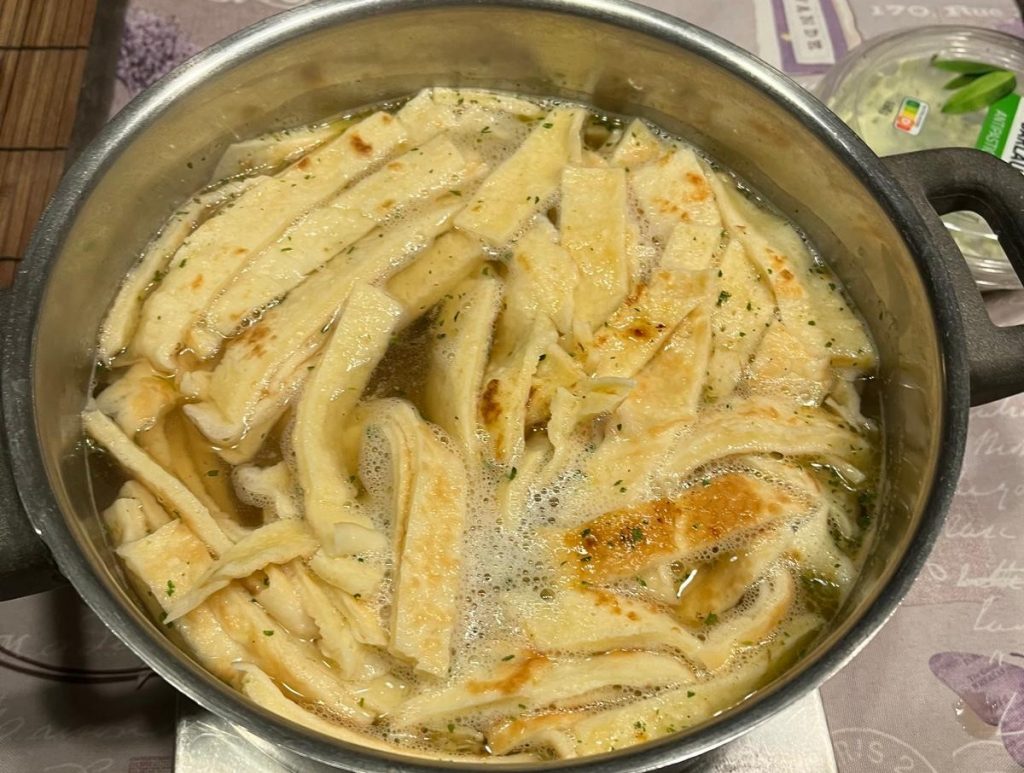
Flädlesuppe ist eine klassische schwäbische Vorspeise, die mit wenigen Zutaten auskommt und dennoch wunderbar aromatisch ist. Feine, in Streifen geschnittene Pfannkuchen („Flädle“) werden in einer kräftigen, klaren Brühe serviert. Das Gericht ist einfach zuzubereiten und eignet sich ideal zur Resteverwertung von übrig gebliebenen Pfannkuchen. Mit frischen Kräutern wie Schnittlauch oder Petersilie garniert, ist Flädlesuppe eine herzhafte und wärmende Speise, die besonders an kalten Tagen gut tut.

Fläddlesuppe
Fläddlesuppe

Zutaten für die Flädle

  • 100 g Mehl – Weizenmehl Type 405
  • 125 ml Milch
  • 2 Eier – Größe M
  • Salz und Pfeffer
  • 1 EL Sonnenblumenöl

Zutaten für die Suppe

  • 1 Möhre
  • 100 g Knollensellerie
  • 1 Stange Lauch
  • 1 EL Sonnenblumenöl
  • 1,5 L kräftige Gemüsebrühe – oder Fleischbrühe
  • 1 Bund Schnittlauch
  • Muskat

Zubereitung:

Dauer insgesamt: 40 min

Zubereitung: 30 min

Kochzeit: 10 min

Für die Flädle Mehl, Milch, Eier, Salz und Pfeffer verrühren. Den Teig zugedeckt 20 Minuten quellen lassen. Etwas Öl in einer Pfanne erhitzen und bei mittlerer Hitze 3-4 dünne Pfannkuchen ausbacken. Die Pfannkuchen übereinander legen, zusammenrollen und in Streifen schneiden (Messer oder Schere). Möhre und Sellerie schälen und in dünne Streifen schneiden oder raspeln. Lauch in Ringe schneiden, Schnittlauch klein schneiden. Öl in einem Topf erhitzen und Möhren, Sellerie und Lauch anschwitzen. Dann die Brühe zugeben und alles einmal aufkochen. 10 Minuten bei geringer Hitze köcheln lassen, bis das Gemüse weich ist. Mit Salz, Pfeffer und Muskat abschmecken. Flädle auf tiefe Teller geben, mit der Suppe begießen und alles mit Schnittlauch garnieren.

Nährwerte pro Portion:

Kalorien: 182 kcal

Kohlenhydrate: 29g

Eiweiß: 7g

Fett: 4g

Recette Allemande · Recette en Anglais

Kässpätzle(EN)

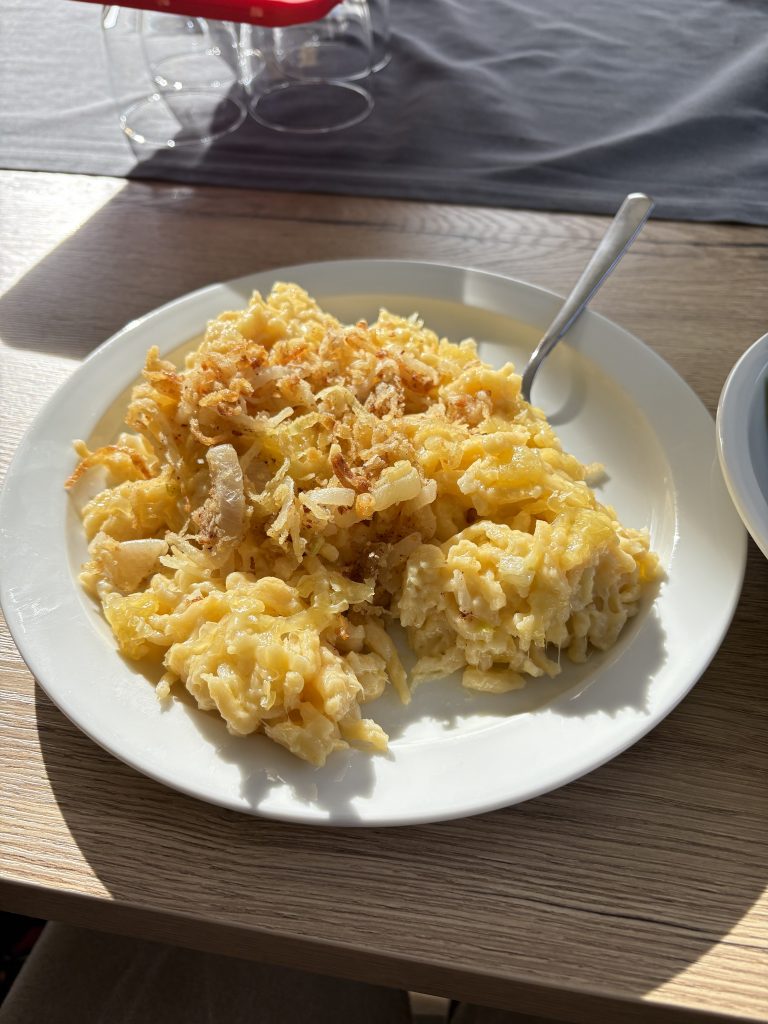
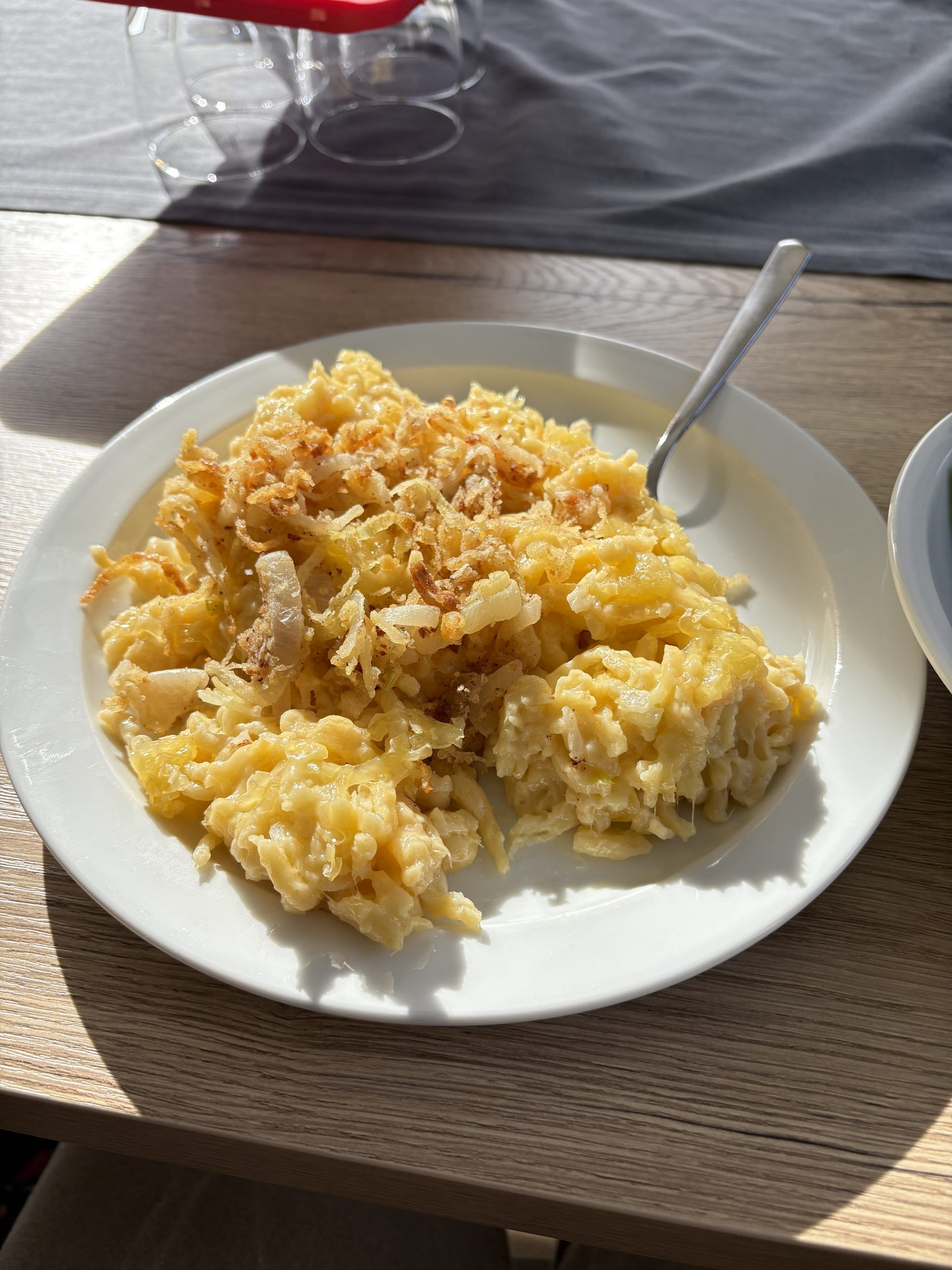
Kässpätzle is a traditional dish from the Allgäu and Swabia regions, consisting of homemade spätzle, melted cheese, and crispy fried onions. The combination of creamy cheese and hearty dough makes it a popular comfort food. Often served with a green salad, it is a true classic of southern German cuisine.

Kässpätzle
Kässpätzle

Ingredients (for 4 people):

For the Spätzle:

  • 400 g flour (Type 405)
  • 4 eggs
  • 150 ml water or milk
  • 1 tsp salt
  • A pinch of nutmeg

For the cheese mixture:

  • 250 g strong mountain cheese (e.g., Allgäu mountain cheese or Emmental), grated
  • 100 g strong Romadur or Limburger cheese (optional, for extra flavor)

For the fried onions:

  • 2 large onions
  • 2 tbsp butter or clarified butter
  • 1 tbsp flour
  • Salt & pepper to taste
  • 1 tbsp butter for mixing
  • Fresh parsley or chives for garnish

Preparation:


Total time: 1 hour

Make the Spätzle dough:

  • Put the flour, eggs, salt, and nutmeg in a bowl.
  • Gradually add the water or milk, stirring until a thick dough forms. The dough should bubble when you beat it vigorously.
  • Let the dough rest for about 10 minutes.

Cook the Spätzle:

  • Bring salted water to a boil in a large pot.
  • Press the dough in portions through a Spätzle press or with a Spätzle board into the boiling water.
  • Once the Spätzle float to the surface, remove them with a slotted spoon and rinse them in cold water.

Prepare the fried onions:

  • Slice the onions into thin rings.
  • Heat butter or clarified butter in a pan.
  • Dust the onion rings with a little flour and fry them until golden brown. Let them drain on paper towels.

Layer and gratinate the Kässpätzle:

  • Preheat the oven to 180°C (350°F) (top/bottom heat).
  • Grease a large pan or baking dish with butter.
  • Layer the Spätzle and grated cheese alternately.
  • Top with small pats of butter and melt in the oven for 10 minutes.

Serve:

  • Garnish the hot Kässpätzle with the fried onions and fresh herbs.
  • Serve with a green salad or a cold beer.

Utensils:

For preparing the Spätzle:

  • Large mixing bowl
  • Hand mixer or whisk
  • Spätzle board, Spätzle press, or a scraper board
  • Large cooking pot
  • Slotted spoon or sieve for draining

For the cheese mixture & preparation:

  • Grater for the cheese
  • Large pan or baking dish
  • Wooden spoon or spatula

For the fried onions:

  • Cutting board
  • Sharp knife
  • Pan
  • Spatula or wooden spoon
  • Paper towels for draining

For serving:

  • Plates or serving dish
  • Tablespoon or fork for portioning
Recette Allemande · Recette en Anglais

Flädlesuppe (EN)

Flädlesuppe is a classic Swabian appetizer that requires few ingredients and is still wonderfully aromatic. Fine pancakes cut into strips („Flädle“) are served in a strong, clear broth. The dish is easy to prepare and is ideal for using up leftover pancakes. Garnished with fresh herbs such as chives or parsley, Flädlesuppe is a hearty and warming dish that is especially good on cold days.

Ingredients:

Ingredients for the Flädle

  • 100 g flour – wheat flour type 405
  • 125 ml milk
  • 2 eggs – size M
  • Salt and pepper
  • 1 tbsp sunflower oil

Ingredients for the Soup

  • 1 carrot
  • 100 g celeriac
  • 1 leek
  • 1 tbsp sunflower oil
  • 1.5 L strong vegetable broth – or meat broth
  • 1 bunch chives
  • Nutmeg

Preparation:

Total duration: 45min

For the pancakes, mix flour, milk, eggs, salt and pepper. Cover the dough and let it soak for 20 minutes. Heat some oil in a pan and fry 3-4 thin pancakes over medium heat. Place the pancakes on top of each other, roll them up and cut them into strips (knife or scissors). Peel the carrot and celery and cut or grate into thin strips. Cut the leek into rings, cut the chives into small pieces. Heat the oil in a saucepan and sauté the carrots, celery and leeks. Then add the broth and bring everything to the boil. Simmer for 10 minutes over low heat until the vegetables are tender. Season with salt, pepper and nutmeg. Transfer the pancakes to deep plates, pour the soup over them and garnish everything with chives.

Nutritional values per person:

Calories: 182 kcal

Carbohydrates: 29g

Protein: 7g

Fat: 4g

Recette Allemande · Recette en Anglais

Ulmer Klösse (EN)

They are called Ulmer Klösse because they were originally made from Ulmer corn flour. Mutschel flour consists of finely ground light bread rolls (Mutschels), which were something very special in the past. The word „Semmelbrösel“ (breadcrumbs) did not appear at all in the Swabian vocabulary (in the region where I come from); it was called Mutschelmehl. Dumplings were cut from the prepared dough and simmered in broth.

Ingredients (for 4 people):

  • 300 grams of old bread
  • 150 grams of water
  • 150 grams of 3.8% milk
  • 1 onion
  • 2 eggs
  • 50 grams of bacon fat
  • Parsley to taste
  • Salt, pepper, nutmeg
  • Breadcrumbs

Préparation:

Total time: 1h 30min
Cooking time: 30 min
Preparation time: 1h

Cut or tear the bread into small pieces and soak it in the water-milk mixture for at least 1 hour. Stir occasionally.

Dice the bacon and fry it. Sauté the onion and parsley in the bacon fat. Let cool.

Squeeze the bread a little. It should not be soaked but well moistened. Mix in a bowl with the bacon, onion, and parsley, then add the 2 eggs. Season with salt, pepper, and nutmeg.

Adjust the seasoning to taste. If the mixture is too „wet,“ add 1 to 2 tablespoons of breadcrumbs to bind it.

Cut strips of plastic wrap that will later fit in the pot and are large enough to seal the ends tightly. Spread soft butter on the wrap and use a spoon to place small heaps of dough close together.

Fold and roll into a round shape. Let it steep in boiling water for 30 minutes. Unwrap and serve with rich sauces like goulash.

Utensils:

  • Scissors – for cutting the plastic wrap
  • Cutting board – for chopping the bacon and onion
  • Chef’s knife – for chopping ingredients
  • Bowl – for soaking the bread
  • Large pan – for frying the bacon and cooking the rest of the ingredients
  • Wooden spoon – for stirring while cooking
Recette Allemande · Recette en Français

Zwetschgenkuchen (FR)

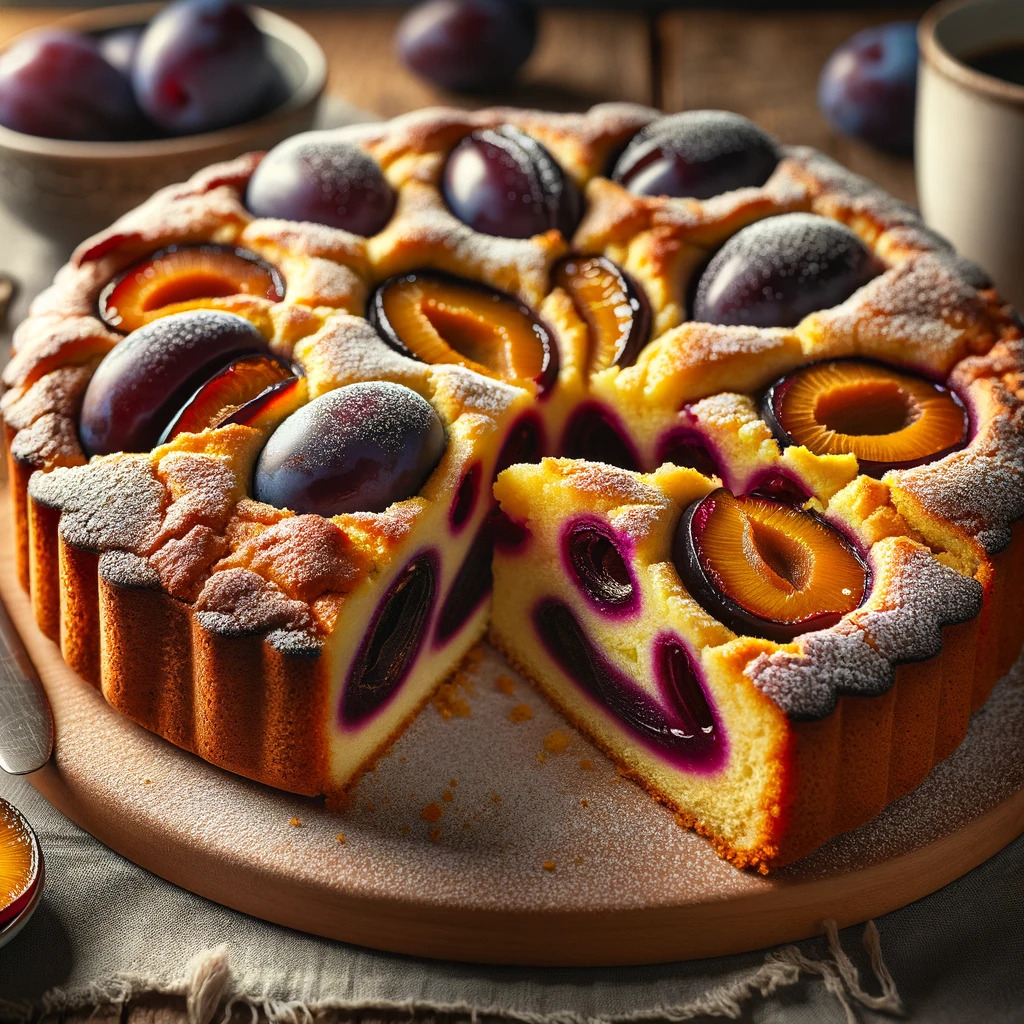
La tarte aux prunes est un délicieux dessert apprécié dans de nombreuses cultures, notamment en Allemagne, où le Zwetschgenkuchen est une friandise populaire, que ce soit avec un café l’après-midi ou comme dessert, la tarte aux prunes est un réconfortant favori de saison, surtout à la fin de l’été et au début de l’automne.

Ingrédients

  • 400 g de farine
  • 1 sachet de levure boulangère
  • 185 g de sucre
  • 1 pincée de sel
  • 150 ml de lait
  • 125 g de beurre
  • 1 oeuf
  • 1 kg de prune
  • 1 cuillère a café de cannelle (optionnelle)

Instructions :

Temps total de la recette : 35-40 min

Mélangez la farine, la levure, le sucre et le sel dans un bol. Ajoutez le lait tiède, le beurre fondu et l’œuf. Pétrissez la pâte jusqu’à ce qu’elle soit lisse et élastique. Laissez-la reposer dans un endroit chaud pendant environ 1 heure, jusqu’à ce qu’elle double de volume.

Pendant que la pâte lève, dénoyautez et coupez les quetsches en deux. Réservez.

Mélangez la farine et le sucre dans un bol. Ajoutez le beurre en petits morceaux et travaillez du bout des doigts pour obtenir un mélange sableux.

Étalez la pâte sur une plaque de cuisson ou dans un moule à tarte beurré. Disposez les quetsches coupées en deux sur la pâte, côté coupé vers le haut. Saupoudrez de sucre et de cannelle. Si vous utilisez de la cannelle, saupoudrez-le également sur les prune.

Préchauffez votre four à 180°C (350°F). Faites cuire la tarte pendant environ 35-40 minutes, jusqu’à ce que les quetsches soient tendres et légèrement caramélisées.

Ustensiles

  • Un grand bol pour mélanger la pâte
  • Une cuillère en bois ou une spatule pour mélanger les ingrédients
  • Un rouleau à pâtisserie pour étaler la pâte
  • Un moule à tarte ou une plaque de cuisson
  • Un couteau pour couper et dénoyauter les quetsches
  • Un petit bol pour préparer le streusel (facultatif)
  • Une balance de cuisine ou des tasses à mesurer pour peser les ingrédients
  • Une râpe à cannelle (si vous utilisez de la cannelle fraîche)
Recette Allemande · Recette en Français

Kässpätzle(FR)

Les Kässpätzle sont un plat traditionnel de l’Allgäu et de Gericht, composé de spätzle faits maison, de fromage fondu et d’oignons frits croustillants. L’association du fromage crémeux et de la pâte savoureuse en fait un plat réconfortant très apprécié. Souvent servis avec une salade verte, ils sont un véritable classique de la cuisine du sud de l’Allemagne.

Kässpätzle
Kässpätzle

Ingrédients (pour 4 personnes) :

Pour les spätzle :

  • 400 g de farine (type 405)
  • 4 œufs
  • 150 ml d’eau ou de lait
  • 1 c. à café de sel
  • 1 pincée de muscade

Pour le mélange de fromages

  • 250 g de fromage de montagne affiné (ex. Bergkäse de l’Allgäu ou Emmental), râpé
  • 100 g de Romadur ou Limburger (optionnel, pour plus de saveur)

Pour les oignons frits

  • 2 gros oignons
  • 2 c. à soupe de beurre ou de saindoux
  • 1 c. à soupe de farine
  • Sel et poivre selon goût
  • 1 c. à soupe de beurre pour mélanger
  • Persil frais ou ciboulette pour la garniture

Préparation :

Temps total : 1 heure

Préparer la pâte à spätzle

Dans un saladier, mélanger la farine, les œufs, le sel et la muscade.

Ajouter progressivement l’eau ou le lait en remuant jusqu’à obtenir une pâte épaisse et élastique. La pâte doit former des bulles lorsqu’elle est bien battue.

Laisser reposer 10 minutes.

Cuire les spätzle

Porter une grande casserole d’eau salée à ébullition.

Verser la pâte en portions dans une presse à spätzle ou utiliser une râpe à spätzle pour les former directement dans l’eau bouillante.

Dès qu’ils remontent à la surface, les retirer avec une écumoire et les plonger dans de l’eau froide.

Préparer les oignons frits

Couper les oignons en fines rondelles.

Faire chauffer le beurre ou le saindoux dans une poêle.

Saupoudrer les oignons de farine et les faire revenir jusqu’à ce qu’ils soient bien dorés et croustillants.

Les déposer sur du papier absorbant.

Monter et gratiner les Kässpätzle

Préchauffer le four à 180°C (chaleur traditionnelle).

Beurrer une grande poêle allant au four ou un plat à gratin.

Alterner des couches de spätzle et de fromage râpé.

Déposer quelques morceaux de beurre sur le dessus et enfourner 10 minutes jusqu’à ce que le fromage soit bien fondu.

Parsemer les Kässpätzle chauds d’oignons frits et d’herbes fraîches.

Servir avec une salade verte et une bière fraîche.

Ustensiles :

Pour la préparation des spätzles:

  • Grand saladier
  • Fouet ou batteur électrique
  • Presse à spätzle, râpe à spätzle ou planche avec un racloir
  • Grande casserole
  • Écumoire ou passoire

Pour le mélange de fromages et la préparation

  • Râpe à fromage
  • Grande poêle ou plat à gratin
  • Cuillère en bois ou spatule

Pour les oignons grillés

  • Planche à découper
  • Couteau bien aiguisé
  • Poêle
  • Spatule ou cuillère en bois
  • Papier absorbant

Pour le service

  • Assiettes
  • Cuillère ou fourchette

Recette Allemande · Recette en Anglais

Zwiebelrostbraten (EN)

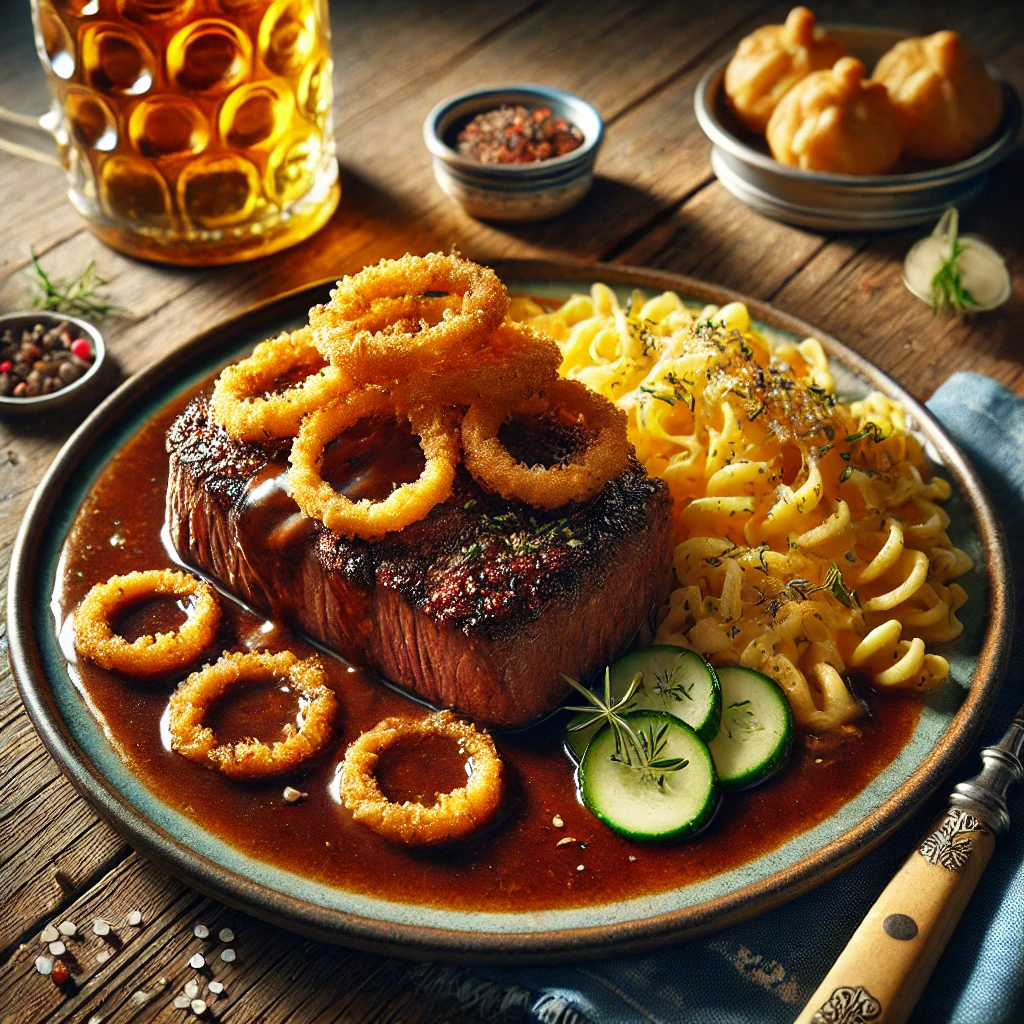
Zwiebelrostbraten is a traditional German dish, particularly popular in Austria and Germany. It consists mainly of roast beef slices, often from tender cuts like sirloin, served with a rich sauce made of caramelized onions, beef broth, and red wine. The dish is commonly accompanied by mashed potatoes, green vegetables, or roasted potatoes.

Ingredients (4 personnes) :

  • 600g of beef
  • 2 to 3 large onions
  • Butter or oil
  • 250 ml beef broth
  • 100ml red wine
  • 1 to 2 tablespoons balsamic vinegar or red wine vinegar
  • Thyme
  • 1 or 2 leaves bay leaf
  • Salt and pepper
  • Flour
  • Crème fraîche

Preparation :

Total time: 1 hour

Prepare the onions:
Heat some butter or oil in a pan over medium heat. Add the thinly sliced onions and cook them slowly, stirring occasionally, until they are golden brown and caramelized. This process can take about 15-20 minutes. Once done, set the onions aside.

Cook the beef:
In the same pan, increase the heat and sear the beef on both sides until it is nicely browned (about 3-4 minutes per side, depending on your preferred level of doneness). Once seared, reduce the heat to medium and continue cooking the beef to your desired level (around 5-7 minutes more for medium, or longer for well-done).

Prepare the sauce:
Once the beef is cooked, remove it from the pan and set it aside to rest. Deglaze the pan by adding the red wine, scraping up any bits stuck to the bottom of the pan. Add the beef broth, balsamic vinegar (if using), thyme, and bay leaf. Bring the sauce to a simmer and let it cook for about 10 minutes to reduce slightly and allow the flavors to meld.

Thicken the sauce (optional):
If you’d like a thicker sauce, you can add a little flour or cornstarch. Mix the flour with a bit of water to make a slurry, and stir it into the sauce. Cook for another 2-3 minutes to thicken the sauce to your liking.

Finish the sauce:
If desired, add some crème fraîche for a richer, creamier sauce. Season the sauce with salt and pepper to taste.

Serve:
Slice the rested beef into thin slices and arrange it on plates. Spoon the sauce over the beef, and top with the caramelized onions. Serve with your choice of side dishes, such as mashed potatoes, steamed vegetables, or fries.

Ustensiles :

  • Large frying pan
  • Sharp knife
  • Cutting board
  • Wooden spoon or spatula
  • Tongs or meat fork
  • Small bowl
  • Measuring cups and spoons
  • Saucepan (optional)
  • Plate or serving dish

Recette Allemande · Rezept auf Deutsch

Kässpätzle(DE)

Kässpätzle sind ein traditionelles Gericht aus dem Allgäu und Schwaben, bestehend aus selbstgemachten Spätzle, geschmolzenem Käse und knusprigen Röstzwiebeln. Die Kombination aus cremigem Käse und herzhaftem Teig macht sie zu einem beliebten Wohlfühlessen. Oft mit einem grünen Salat serviert, sind sie ein echter Klassiker der süddeutschen Küche.

Kässpätzle
Kässpätzle

Zutaten (für 4 Personen):

Für die Spätzle:

  • 400 g Mehl (Typ 405)
  • 4 Eier
  • 150 ml Wasser oder Milch
  • 1 TL Salz
  • 1 Prise Muskatnuss

Für die Käsemischung:

  • 250 g würziger Bergkäse (z. B. Allgäuer Bergkäse oder Emmentaler), gerieben
  • 100 g würziger Romadur oder Limburger (optional, für extra Geschmack)

Für die Röstzwiebeln:

  • 2 große Zwiebeln
  • 2 EL Butter oder Butterschmalz
  • 1 EL Mehl
  • Salz & Pfeffer nach Geschmack
  • 1 EL Butter zum Vermengen
  • Frische Petersilie oder Schnittlauch zum Garnieren

Zubereitung:

Mehl, Eier, Salz und Muskat in eine Schüssel geben.

Nach und nach das Wasser oder die Milch einrühren, bis ein zähflüssiger Teig entsteht. Der Teig sollte Blasen werfen, wenn man ihn kräftig schlägt.

Den Teig etwa 10 Minuten ruhen lassen.

Spätzle kochen

In einem großen Topf Salzwasser zum Kochen bringen.

Den Teig portionsweise durch eine Spätzlepresse oder mit einem Spätzlehobel ins kochende Wasser drücken.

Sobald die Spätzle an die Oberfläche steigen, mit einer Schaumkelle herausnehmen und in kaltem Wasser abschrecken.

Röstzwiebeln zubereiten

Die Zwiebeln in feine Ringe schneiden.

Butter oder Butterschmalz in einer Pfanne erhitzen.

Die Zwiebelringe mit etwas Mehl bestäuben und goldbraun braten. Auf einem Küchentuch abtropfen lassen.

Kässpätzle schichten und gratinieren

Den Backofen auf 180 °C (Ober-/Unterhitze) vorheizen.

Eine große Pfanne oder eine Auflaufform mit Butter einfetten.

Spätzle und geriebenen Käse abwechselnd schichten.

Zum Schluss mit Butterflöckchen belegen und für 10 Minuten im Ofen schmelzen lassen.

Servieren

Die heißen Kässpätzle mit den Röstzwiebeln und frischen Kräutern garnieren.

Dazu passt ein grüner Salat oder ein kühles Bier.

Utensilien :

Für die Spätzlezubereitung:

  • Große Rührschüssel
  • Handmixer oder Schneebesen
  • Spätzlehobel, Spätzlepresse oder ein Brett mit Schaber
  • Großer Kochtopf
  • Schaumlöffel oder Sieb zum Abschöpfen

Für die Käsemischung & Zubereitung:

  • Reibe für den Käse
  • Große Pfanne oder Auflaufform
  • Holzlöffel oder Teigschaber

Für die Röstzwiebeln:

  • Schneidebrett
  • Scharfes Messer
  • Pfanne
  • Pfannenwender oder Kochlöffel
  • Küchenpapier zum Abtropfen

Zum Servieren:

  • Teller oder Servierschale
  • Esslöffel oder Gabel zum Portionieren

Recette Allemande · Recette en Français

Ulmer Klösse (FR)

On les appelle Ulmer Klösse parce qu’ils étaient à l’origine fabriqués à partir de farine de maïs d’Ulmer. La farine de Mutschel est composée de petits pains légers (Mutschels) très finement moulus. Quelque chose de très spécial dans le passé. Le mot Semmelbrösel n’apparaissait pas du tout dans le vocabulaire souabe (dans la région d’où je viens), c’était Mutschelmehl. Des boulettes ont été découpées dans la pâte à boulettes obtenue et mijotées dans du bouillon.

Ingrédient (pour 4 personnes):

  • Du vieux pain : 300 grammes
  • Eau : 150 grammes
  • lait 3,8% : 150 grammes
  • 1 Oignon
  • 2 œufs
  • graisse de bacon : 50 grammes
  • persil à volonté
  • sel, poivre, muscade
  • chapelure

Préparation:

Durée totale : 1h 30min
Temps de cuisson: 30 min
Temps de préparation: 1h

Coupez ou déchirez le pain en petits morceaux et faites-le tremper dans le mélange eau-lait pendant au moins 1 heure. Remuez de temps en temps.

Coupez le bacon en dés et faites-le frire. Faites-y revenir l’oignon et le persil. Laisser refroidir. 

Pressez un peu le pain. Il ne doit pas être trempé, mais bien humidifié. Mélanger dans un bol avec le bacon, l’oignon et le persil et incorporer 2 œufs. Ajoutez du sel, du poivre et de la muscade pour assaisonner.

Assaisonner selon votre goût. Si le mélange est maintenant trop « humide », ajoutez 1 à 2 cuillères à soupe de chapelure pour le lier. 

Coupez des bandes de film alimentaire qui s’adapteront plus tard à la marmite et qui sont également suffisamment grandes pour sceller hermétiquement les extrémités. Étalez du beurre mou sur la plaque et utilisez une cuillère à soupe pour déposer de petits tas de pâte rapprochés.

Pliez et roulez en forme ronde. Laissez infuser dans l’eau bouillante pendant 30 minutes. Déballez et servez avec des plats riches en sauce comme le goulasch.

Ustensiles :

  • Ciseau – pour couper le film alimentaire
  • Planche à découper – pour découper la poitrine de porc, les aubergines, l’oignon et l’ail.
  • Couteau de chef – pour découper les ingrédients.
  • Bol – pour tremper les tranches d’aubergine dans l’eau avec du vinaigre blanc.
  • Grande poêle – pour faire revenir la poitrine de porc et cuire le reste des ingrédients.
  • Cuillère en bois – pour mélanger les ingrédients pendant la cuisson.